First data in RA - Cytodata 2025
Dec 11, 2025
Ize Buphamalai et al.
Now reading:
First data in RA - Cytodata 2025
Author
Ize Buphamalai et al.
Date
Dec 11, 2025
12/11/25
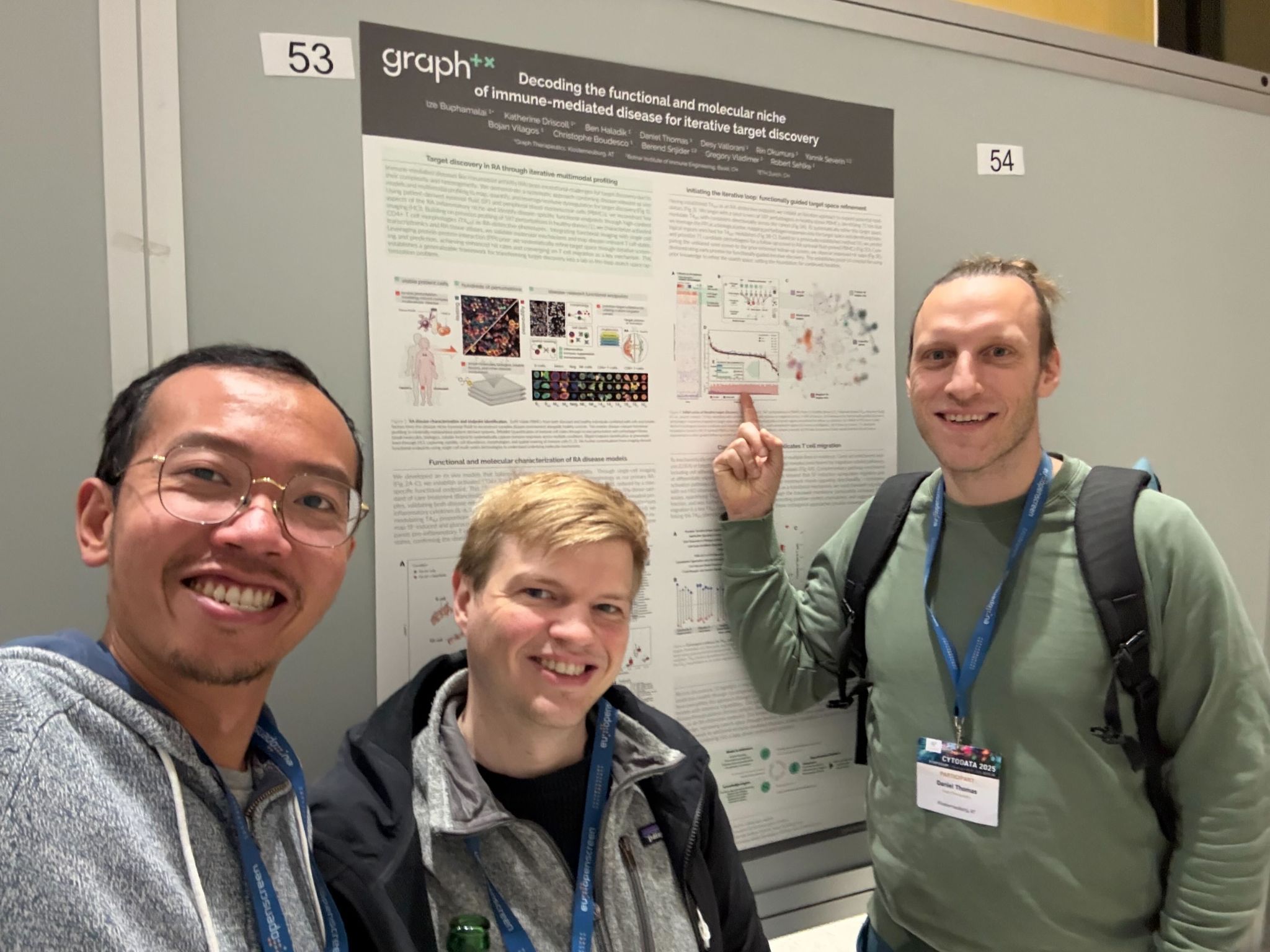
Immune-mediated diseases are highly complex and heterogeneous, which makes the discovery of precision medicines difficult. In Graph’s most recent poster at CytoData 2025, our research team showcased our systematic approach to address this challenge. 🎯
By using rheumatoid arthritis (RA) as a case study, the Graph team demonstrates a generalizable framework that can work in iterative cycles of lab experimentation and prediction, i.e. a lab-in-the-loop approach 🔁, to systematically understand mechanisms and drivers of the disease. Key to the success of our approach are three main components:
We perturb viable cells directly from the patient, so called ex vivo models, which are a closer mirror of the disease than commonly used cell lines.
We integrate our findings using a knowledge engine that takes in known biology alongside our new data to narrow the search space of potential drug targets, as well as predict new promising targets.
We validate the predicted targets in the lab, contributing to our knowledge base and making future predictions even more accurate.
Check out the full poster here: https://graphtx.com/Graph_CytoData_2025.pdf
Immune-mediated diseases are highly complex and heterogeneous, which makes the discovery of precision medicines difficult. In Graph’s most recent poster at CytoData 2025, our research team showcased our systematic approach to address this challenge. 🎯
By using rheumatoid arthritis (RA) as a case study, the Graph team demonstrates a generalizable framework that can work in iterative cycles of lab experimentation and prediction, i.e. a lab-in-the-loop approach 🔁, to systematically understand mechanisms and drivers of the disease. Key to the success of our approach are three main components:
We perturb viable cells directly from the patient, so called ex vivo models, which are a closer mirror of the disease than commonly used cell lines.
We integrate our findings using a knowledge engine that takes in known biology alongside our new data to narrow the search space of potential drug targets, as well as predict new promising targets.
We validate the predicted targets in the lab, contributing to our knowledge base and making future predictions even more accurate.
Check out the full poster here: https://graphtx.com/Graph_CytoData_2025.pdf
Read More
Graph partners with Parse Biosciences
Graph partners with Parse Biosciences
News
Jan 20, 2026
1/20/26
Data Foundations of Precision Immunology
Data Foundations of Precision Immunology
Article
Nov 24, 2025
11/24/25
First data in RA - Cytodata 2025
First data in RA - Cytodata 2025
Research
Dec 11, 2025
12/11/25
Graph and BIIE announce strategic collaboration to in precision immunology
Graph and BIIE announce strategic collaboration to in precision immunology
News
Oct 7, 2025
10/7/25
Graph awarded €1.1M Deep Tech Grant
Graph awarded €1.1M Deep Tech Grant
News
Apr 22, 2025
4/22/25
GTX co-founder appointed as Faculty Professor at the BIIE
GTX co-founder appointed as Faculty Professor at the BIIE
News
Mar 28, 2025
3/28/25
Graph Awarded €1.1M "Austrian Life Sciences" FFG Grant
Graph Awarded €1.1M "Austrian Life Sciences" FFG Grant
News
Mar 3, 2025
3/3/25
Graph Raises $3.1M Pre-Seed Round
Graph Raises $3.1M Pre-Seed Round
News
Dec 10, 2025
12/10/25
Copyright GraphTx 2026
Vienna, Asutria
Vienna, Austria
All system opperational